Showing posts with label roast tomatoes. Show all posts

Monday, October 24, 2011

Odds and Ends of Summer


I realized I have all these random pictures of things I did at the end of the summer and haven’t had time to write about. Now that it’s about to snow tomorrow, I’ve got time.

Tomatoes
When we picked our tomatoes, we had a giant bowl of green tomatoes. They did turn red, but before they did, I made one of Walt’s favorite dishes. They aren’t my favorite, but I’ll cook and eat them because he is so happy when I make:

FRIED GREEN TOMATOES
1 medium green tomato per person     
Salt     
Freshly ground pepper
Cornmeal     
Bacon drippings, or shortening 

Slice tomatoes about ½ inch thick,


season with salt and pepper


and then coat both sides with cornmeal.


In a large skillet, heat enough drippings or shortening to coat the bottom of the pan and fry tomatoes until lightly browned on both sides.


We had LOTS of tomatoes when we picked them before the first big storm. So I made roasted tomatoes. These are wonderful on toast, pizza, in spaghetti sauce, and just to eat. The sugar in the tomatoes caramelizes so they are incredibly sweet.

Roasted tomatoes
Roma tomatoes  
Garlic salt   
Pasta sprinkle (oregano, basil, etc.)
Olive oil
Freshly ground pepper 

Oven 325˚. Pour olive oil on baking sheet. Cut tomatoes in halves or thirds. Dip both sides in oil.
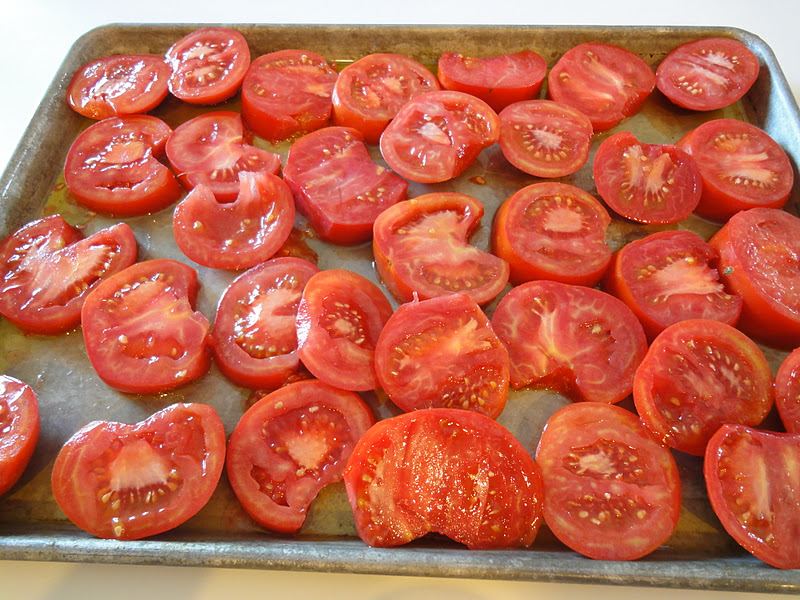

Sprinkle with salt, pepper, herbs.


Bake for 2 hours till soft and shriveled. Restrain yourself from eating all the tomatoes on the pan and licking it clean.


When we harvested the things in the front gardens, I made this for dinner:


LAST OF SUMMER OMELET
2 eggs per person
Onion, chopped
1 minced clove garlic
Tomato, chopped or sliced
Swiss chard, chopped
Half and half
Grated cheese
Salt and fresh grated pepper to taste
Butter

Sauté the onion and garlic in some butter for 5 minutes. Add tomato and Swiss chard. Stir fry until chard is limp. Meanwhile, beat the eggs with some half and half, salt and pepper. Remove the vegetables from the pan. Melt some more butter. Pour in the eggs. Cook the eggs, lifting the edges so the uncooked part can get to the bottom of the pan. Keep cooking until the eggs are nearly set. Put the vegetables on half of the omelet. Sprinkle on grated cheese. Gently lift the other half of the omelet over the vegetables. Slide out of the pan onto a plate. Doesn’t that sound so easy? Just slide it out? That happens about 1 time in 5 that it comes out beautifully, but that’s ok. It still tastes wonderful.

Decorative Corn
This year, I figured if we could grow corn in the garden, I could do an early variety of decorative corn. You can’t eat them – well, I guess you could scrape off the hard kernels and grind them with your mortar and pestle like Native American women used to do. Oh my.

The corn stalks are pretty – some of them are red or purple just like the corn. After picking the ears, we soaked them in a bucket of water for half an hour or so. Then Walt patiently sat on the deck and pulled back the husks to expose the corn and make them look pretty. This was one of the fun things – seeing what each ear looked like. We got enough to give each of our daughters some and several for ourselves. I will definitely plant more next year.


Basket
When I go out to the garden, I carry my basket. The first few years, I would take a giant stainless steel bowl, but everything would get jumbled in the bottom of the bowl. I looked everywhere for a basket big and sturdy enough with a handle. I finally found an Amish basket maker online and got this one. I love it. I do.


Bees
I plant lots of flowers and shrubs that will attract bees. Bees are having a tough time of it these days with colony collapse disorder. This kills off the entire hive of bees. Without bees, we wouldn’t have almonds, broccoli, cashews, watermelon, squash, pumpkin, tangerines, lemons, apples, peaches, strawberries, you name it. These little busy creatures are responsible for the pollination of most of the fresh foods we eat.


I’ve found they love the Russian sage, the climbing roses, the marigolds, and the Echinacea. So I plant these things and the bees, in turn, pollinate the tomatoes, the squash, the pumpkins, the chokecherries, and things I probably don’t even know about. I’m grateful for their work ethic.

Pests
Eeewwww

Conversely, I hate grasshoppers. Really. They eat the potato vines, the corn, the Swiss chard, the spinach and the bean leaves. I pride myself on growing things organically, but we finally had to break down and get some grasshopper-killing-bran. Last year, they stripped the potato vine leaves in a couple of days. This year, we got an early start on sprinkling the bran on the potato leaves and didn’t have as much of a problem with the hoppers in that bed. But they were still a problem. They nibble on just-ripening tomatoes. Makes me crazy. So I become a ruthless killer around the tomatoes. Scissors are my weapon of choice. The hoppers will flee if they see my hand or foot, but they don’t recognize scissors as a threat. So I decapitate the nasty hoppers. It’s gross, but I do get a bit of satisfaction that one less hopper will survive to make baby hoppers. And chomp my tomatoes.


This is not a pest - just a really cool spider picture

Fall leaves
This has nothing to do with anything except pretty.


We’ve had the prettiest fall, even with that 7” of snow that fell a few weeks ago. The snow was just the icing on the cake, as it were, for fall watering of trees and shrubs.


But I took this today


Clothesline
We’ve lived in about nine houses in the course of our married life. Of those nine, seven have had a clothesline. In fact, when we built the house we currently live in, I asked the builder to put in a clothesline. His look said it all: “You do know that they’ve invented dryers, right?” But he was too kind to say it out loud. Just smiled and nodded.


I love the way sheets and towels smell when they hang on the line. I love putting those sheets on the bed and that they are smooth and fresh. In the summer, on a warm breezy day, they dry faster than if they were in the dryer. If the temperature is above 60° and the wind isn’t blowing a gale, sheets and towels go on the line. Even when it’s like this:

They even got dry

Missy
I have a running buddy. Her life consists of waiting for me in the morning to go run. Going for a run. Then waiting another 24 hours to go for a run. When I go out to garden, she follows me. She follows me everywhere I go. She sits and watches everything I do, in case I decide to drop everything and go for a run. So I talk to her. I tell her what I’m going to pick next or where I need to move a hose. She’s extremely understanding and patient and wise. She agrees with everything I tell her. She thinks if she does, we’ll go for a run.


Saturday, October 8, 2011

Tomatoes - Part Two


I know this is going to sound weird, but the truth is that tomatoes are remarkably easy to grow – even at 6,000 feet elevation in Wyoming. Even with the wind. Even with the hail. I start them in the sun room in March along with the chilies, but you can buy tomatoes plants at a nursery. I like to start them myself because I can grow some heirloom varieties – big purple Cherokee, or Brandywine, or Black Krim, to name a few. I grow a few varieties that will ripen early and some that ripen late in the season. I grow cherry tomatoes – red, gold, or black (I didn’t like the black ones as well – they don’t produce as many as the red or especially the gold ones). Cherry tomatoes are amazingly prolific. They come on a few at a time –they are so sweet that they’re like growing candy in the garden – then you get an avalanche of cherry tomatoes until the first freeze.


I start the tomato seeds in peat pots and plant several in a pot. I thin them later. I’ve tried all sorts of different seed markers through the years and have yet to come up with a satisfactory way to mark each pot. The little plastic markers are great till I plant the tomatoes outside, then the writing disappears through the summer. They only help when I’m planting the tomatoes – I know which plants to plant together.

We have a lovely garden bed on the south side of the house. It’s probably a big factor in our success with tomatoes. It faces south, so it’s warm and it’s up against an exterior brick wall, which makes it warmer still. Walt built 6 different trellises out of PVC pipe  and construction wire – four of them are 8’ tall and two are 4’ tall. The tall trellises are on the ends – they are for the cherry tomatoes. The short ones are under a window – they are for the shorter varieties.


We compost this bed heavily and use drip irrigation because tomatoes like lots of water and lots of heat. They like being protected from the wind. They’re notoriously sensitive, but the truth is that if you give them half a chance, they actually do really well – even in our high altitude environment.

If you are limited for space and only have room for a planter – plant a tomato. Go to the nursery and buy a quick ripening variety. As it grows, stake it up and tie the plant to a stake. Plant some basil seeds around the rim of the planter. You’ll get enough tomatoes to enjoy fresh ones in late August with some fresh basil.

When the weather warms up around the first part of June, I plant the tomatoes – peat pot and all. That way, they don’t have too much transplant shock. I tie them up immediately on to the trellis as I plant them. Cheyenne has lots of wind in June and I want the tomatoes to put their energy into growing tomatoes, not trying to stay upright.

I keep them weeded, mulch with grass clippings to keep the weeds down and keep tying them up as the summer progresses. Some of the cherry tomatoes grow about 8’ tall and all the tomatoes need the support of being tied. We used to do tomato cages but the trellises work so much better, especially for the taller plants.
 
About mid-August, I prune. I cut off all the shoots and stems that have blossoms on them – not the main ones with tomatoes on them. There is not enough time by mid-August for those blossoms to make tomatoes and I want the plant’s energy to go to ripening tomatoes, not making more. By this time, we’re eating cherry tomatoes, but I still prune them where I can.


I pick the tomatoes as they ripen – at first a few, then enough to make  

Simple GARDEN Marinara Sauce
1/2 cup extra-virgin olive oil
1 large onion, diced
5 garlic cloves, minced
2-3 small or 1 large zucchini, rough chopped
2-3 rough chopped carrots
2 tbsp. each chopped fresh parsley and basil
1/2 teaspoon sea salt
1/2 teaspoon freshly ground black pepper
2 qts. fresh tomatoes, chopped
2 dried bay leaves

That's one of those big Cherokee purple tomatoes

Sauté the onions, carrot and garlic in olive oil until soft, about 7 minutes. Add the zucchini and sauté for another 1-2 minutes. Add bay leaves. Add the tomato, salt pepper, and the parsley and basil.


Let simmer for 1 - 1 1/2 hours, or longer depending on the variety of your tomatoes.


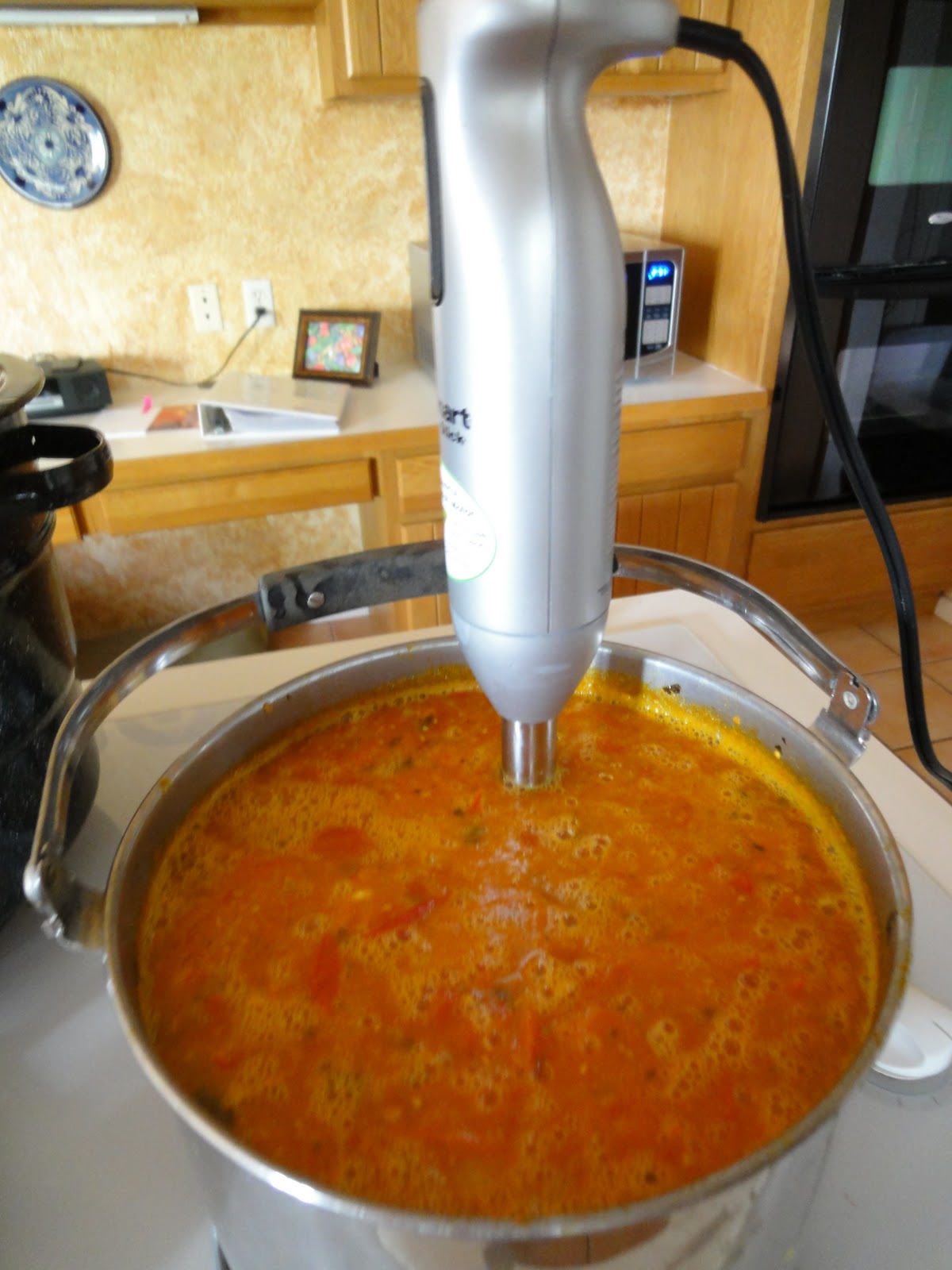
When finished simmering, remove bay leaves, and puree until smooth.

I love my immersion blender for just this reason!

Then I put them in 1 qt. Ziploc freezer bags; but I just freeze 2 cups in each bag.

Or this makes a richer tasting variation:
Roasted Marinara Sauce
Use above proportions. Cut all vegetables in 1” pieces. Slice garlic. Place all on baking sheet. Drizzle with olive oil. Sprinkle with salt and pepper. Roast at 300°, stirring occasionally, about an hour or more or till very dark. Put in pot. Simmer till thick. Puree.

Or make salsa (see the salsa blog).


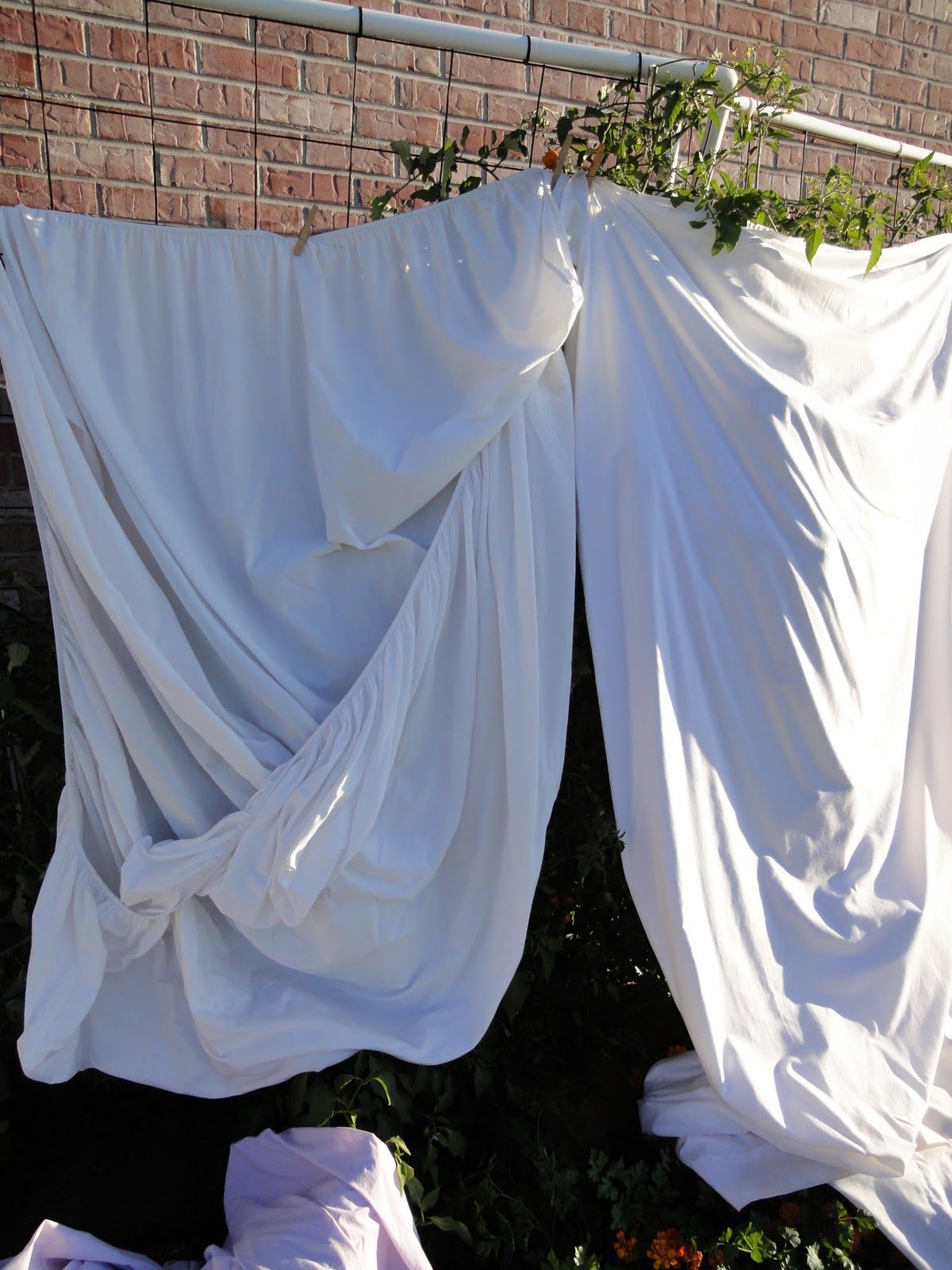
Although the weather pattern in Cheyenne has changed, we still get a threat of frost in mid-to late-September. If it’s just a threat and not a major weather change, we cover the trellises with sheets for the night. It looks like a visitation of ghosts, but protects the tomatoes (and chilies). Then we have another few weeks of summer-like weather to ripen the last of the tomatoes.


Last year, we picked about 150 pounds of tomatoes; almost that much this year. After making marinara and salsa, I freeze the rest. This is the easiest way to do tomatoes – much easier than bottling them. Just wash them well, cut off the stem end and any blemishes, and put them in freezer bags. That’s it.


Then when you take them out of the freezer to use in soups, stews, spaghetti sauce, or what have you, let them sit on the counter for 30 or 60 minutes. Run them under some warm water and the skins slip right off. While they are still partly frozen, I chop them up to add them to whatever I’m cooking. A quart Ziploc bag equals about a can of tomatoes.

Here are some other family favorites:
SPAGHETTI SAUCE
1 chopped onion    
1 chopped green pepper       
1 lb. ground meat        
½ lb. sliced mushrooms      
3 cloves garlic, minced      
1 (6 oz.) can tomato paste
1 can tomatoes, or bag of frozen tomatoes
1 tsp. beef bouillon
1 c. water (approx.)
½  tsp. rosemary
1 ½ tsp. basil   
Dash of cinnamon
Brown meat till crumbly, add onion and green pepper when meat is nearly done. Drain meat if necessary. Add all remaining ingredients except herbs and cinnamon. Bring to boil, simmer till thick (about 1 hour), add herbs and cinnamon. Simmer 20-30 minutes more. Stir occasionally.

Heirloom Tomato Soufflé with Mozzarella
2 tbs. finely grated parmesan
3 tbs. butter
3 tbs. flour
1 ¾ c. milk, warmed
½ tsp. sea salt
¼ tsp. freshly ground black pepper
Pinch of nutmeg
5 large eggs separated
1 tbs. pesto
2 c. chopped tomato
1 c. shredded mozzarella
Oven - 400°. Spray an 8 c. soufflé dish with Pam. Dust bottom and sides with parmesan.
Heat butter in large saucepan, stir in flour. Cook 3 minutes over medium heat stirring occasionally, till light beige in color. Whisk in warm milk. As mixture bubbles, stir in salt, pepper, and nutmeg. Remove from heat and cool slightly.

In small bowl, whisk together eggs and pesto. Stir into butter mixture with tomatoes and mozzarella. In separate bowl, beat egg whites with pinch of salt till stiff. Fold ¼ of whites into batter and mix gently but thoroughly to lighten the mixture. Fold in remaining whites very gently.

Pour into prepared soufflé dish. Lower temperature of oven to 375°, bake 35 minutes. Center of soufflé should be very slightly wobbly. Remove from oven, serve immediately. Center will still be molten. Serves 3-4

Savory Roasted Tomato Crumble
3 lbs. plum or Roma tomatoes, quartered
3 cloves garlic, thinly sliced
3 sprigs fresh thyme
2 sprigs fresh rosemary
Sea salt and freshly ground black pepper, to taste
2 tbs. olive oil
Oven 300°. Spray roasting pan with cooking spray. Place tomatoes in pan, scatter garlic and herbs over. Season with salt and pepper, drizzle with oil. Cover and bake 1 ½ hours. Remove from oven; discard herbs, set aside to cool. Raise oven to 375°.

Topping:
¾ c. flour
½ c. butter
½ c. fresh bread crumbs
½ c. grated parmesan
¼ c. pine nuts
1 c. shredded mozzarella
In food processor, place flour, bread crumbs and parmesan. Add butter and pulse till pea-size bits. Add pine nuts and pulse for 2 seconds.

Spray a 9”x9” or 8x10” pan with cooking spray. Place tomato mixture in pan. Cover with crumb topping. Bake 45 minutes till golden brown. Remove from oven, turn on broiler, top crumble with mozzarella, broil 3-5 minutes. Cool slightly, and serve hot. Serves 4


I made some pesto the other day (I'll write about that later), spread the pesto on some crusty bread. Then I layered on some tomatoes and mozzarella and broiled it till the mozzarella melted.
 
 
Or you can spread the pesto on the bread and smother it in the marinara sauce.

You deserve this after doing all that cooking

 
 Tomatoes form the basis for countless delicious recipes, and the taste of homegrown tomatoes makes all the difference.


Tomatoes


What’s the song?

There ain't nothing in the world that I like better
than bacon and lettuce and homegrown tomatoes.
Up in the morning, out in the garden, get you a ripe one, don't pick a hard one.
Plant 'em in the spring, eat 'em in the summer. All winter without 'em is a culinary bummer.
I forget all about the sweating and the digging every time I go out and pick me a big one.
Homegrown tomatoes, homegrown tomatoes, what would life be without homegrown tomatoes?
Only two things that money can't buy and that's true love and homegrown tomatoes.


 (By Guy Clark - not a big hit, but full of wisdom)

Store bought tomatoes are pale imitations of the real thing. Store bought tomatoes are produced (not grown) to be picked green, uniform in size, boxed and shipped, turning red in the process, and kept for weeks in a grocery store without bruising. When you cut them, they are pale or white inside. They taste bland and mushy. They taste like nothing.
 
A home-grown tomato starts as a little yellow flower pollinated by bees. It becomes a small green tomato in July. Through July and most of August, it spends its energy in growing larger – some varieties are bigger than a baseball – while still green. Then, towards the end of August, it starts turning a pale pink or pale orange.


Be patient. One day in early September you will go outside and there will be a big, red, tempting tomato. When you pick it, it will be heavy in your hands – juicy and plump.
 
Take it inside and slice it. It is red throughout and the juice will run all over the cutting board.


What to do with it? That depends on the variety. With a big beefsteak type tomato, you can lightly salt it, throw on some basil leaves and you have one of the most wonderful salads in the world.

With some smaller eating tomatoes, you can layer them with basil and fresh mozzarella, drizzle with balsamic vinegar and have a complete meal, especially if you have a fresh baguette or sourdough bread.


With cooking tomatoes, like Roma, roast them and put them on homemade pizza, or make them into tomato sauce for spaghetti.

ROASTED TOMATOES
Roma tomatoes       
Pasta sprinkle (oregano, basil, etc.)
Olive oil
Garlic salt
Freshly ground pepper 

Oven 325˚. Pour olive oil on baking sheet. Cut tomatoes in halves or thirds. Dip both sides in oil. Sprinkle with salt, pepper, herbs. Bake for 2 hours till soft and shriveled.
 
ROASTED TOMATO SAUCE
4 garlic cloves, unpeeled     
2 small red onions, unpeeled, cut in half             
3 lbs. (about 6) medium tomatoes, cored           
2 tbs. balsamic vinegar                  
1 tbs. olive oil                 
1 tbs. tomato paste
1 tsp. sugar
1 tsp. fresh oregano
½ tsp. salt
1/4 tsp. crushed red pepper
1/4 tsp. black pepper

Preheat broiler. Place garlic and onions, skin sides up, on jelly roll pan. Place pan on lower oven rack. Broil 30 minutes. Add tomatoes to pan, core sides down. Cook additional 30 minutes till blackened. Cool 5 minutes. Remove skins from garlic, onion, and tomatoes; discard skins. Place all in food processor or blender; add rest of ingredients, process till smooth. (Can be kept in refrigerator for 1 week, in freezer 1 month). 8 servings over pasta.

One of our favorites is tagliarini – it’s simple, easy and delicious: 


TAGLIARINI
CHICKEN TAG2 large fresh sliced, or a few frozen tomatoes, skinned, or a large can of tomatoes
4 garlic cloves, minced       
1/3 c. olive oil 
¼ tsp. freshly ground black pepper       
¼ c. water (if you use fresh tomatoes)
1 tsp. basil
Salt to taste


In heavy skillet, sauté garlic in oil till garlic just starts to turn golden. Do not let it brown.

Add rest of ingredients, cover, and simmer 10 minutes.


Serve over pasta with parmesan cheese.


Another variation is to sauté 1 tsp. red pepper flakes with the garlic, then add a red bell pepper, chopped 

Or this variation with chicken: 

CHICKEN TAGLIARINI
CHICKEN TAG2 large fresh sliced, or a few frozen tomatoes, skinned, or a large can of tomatoes
4 garlic cloves, minced  
1/3 c. olive oil 
2 chicken breasts, cubed
1 onion, sliced
1 green pepper, sliced     
¼ tsp. freshly ground black pepper      
¼ c. water (if use fresh tomatoes)
1 tsp. basil
Salt to taste                 

In heavy skillet, sauté garlic in oil till garlic just starts to turn golden. Do not let it brown. Remove garlic from oil, add chicken to pan. Brown chicken 4 minutes. Turn, then add onion and pepper, brown chicken 4 minutes.  Add rest of ingredients, cover, and simmer 30 minutes. Serve over pasta with parmesan cheese.

There is so much about tomatoes, that I’ll continue this in part two.